
Advanced Target Profiling in Cancer – A Spatial and Single-Cell Transcriptomics Approach
Overview
Understanding gene function within the tumor microenvironment (TME) is critical for developing next-generation immunotherapies. Spatial transcriptomics and single-cell RNA sequencing (scRNA-seq) technologies enable researchers to study gene expression at cellular resolution while preserving tissue context.
A biotechnology company developing advanced immunotherapies partnered with Excelra to analyze how a specific target gene influences cellular interactions within tumors across multiple cancer types. Leveraging Excelra’s expertise in Bioinformatics Services, Computational Biology, and Precision Medicine analytics, the project aimed to uncover spatially resolved molecular mechanisms driving tumor biology.

Our client
The client is a biotechnology organization focused on developing innovative immunotherapies for cancer patients. Their research required advanced transcriptomics analysis capable of identifying target-gene influence across heterogeneous tumor regions and immune cell populations.
The engagement aligned with modern oncology research trends described in AI-driven precision medicine strategies and spatial omics–enabled drug discovery.

Client’s challenge
The client needed to understand the biological impact of a target gene within the tumor microenvironment across different cancer types.
Key challenges included:
- Identification of appropriate spatial transcriptomics and scRNA-seq datasets from public repositories.
- Understanding how target gene expression influences neighboring cells within tumor tissue.
- Performing comparative analysis between tissue regions with high and low gene expression.
- Generating biologically meaningful insights despite the absence of knockout or knockdown cellular models.
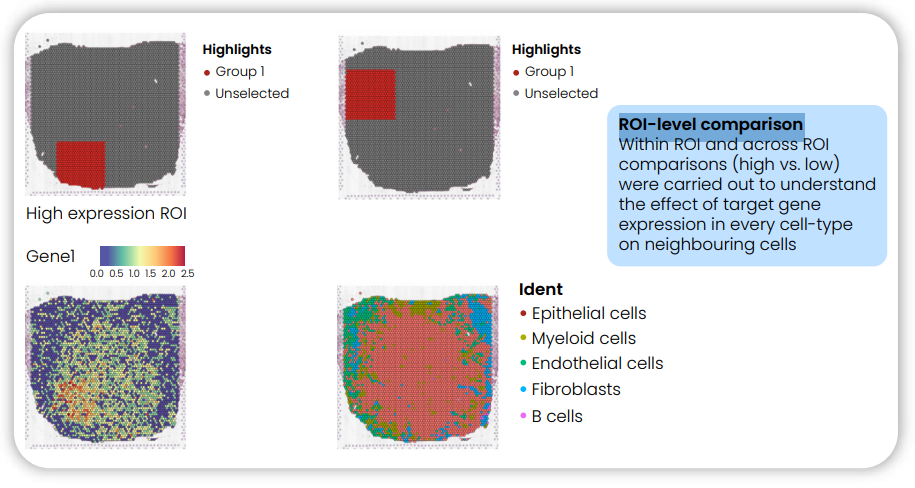
As highlighted in the project documentation, spatial transcriptomics enabled comparative analysis across multiple regions of interest (ROIs), allowing investigation of gene activity within tumor spatial architecture.

Client’s goals
The client aimed to:
- Perform advanced target profiling across multiple cancer subtypes.
- Analyze immune cell abundance relationships with target gene expression.
- Understand molecular signatures driving tumor microenvironment dynamics.
- Identify differentially expressed genes and cytokines influenced by the target.
- Generate actionable insights supporting immunotherapy development.
These objectives align with evolving cancer research workflows supported by spatial omics analysis approaches and multi-omics integration strategies.
Our approach
Excelra executed a multi-stage analytical framework combining transcriptomics analytics, spatial biology, and data science expertise.
Dataset identification
Excelra identified statistically robust datasets across selected cancer subtypes, ensuring sufficient sample size for meaningful biological interpretation. Metadata mining and dataset preparation leveraged structured workflows similar to Data Curation Services and analysis-ready dataset methodologies discussed in analysis-ready clinical datasets.
scRNA-seq analysis
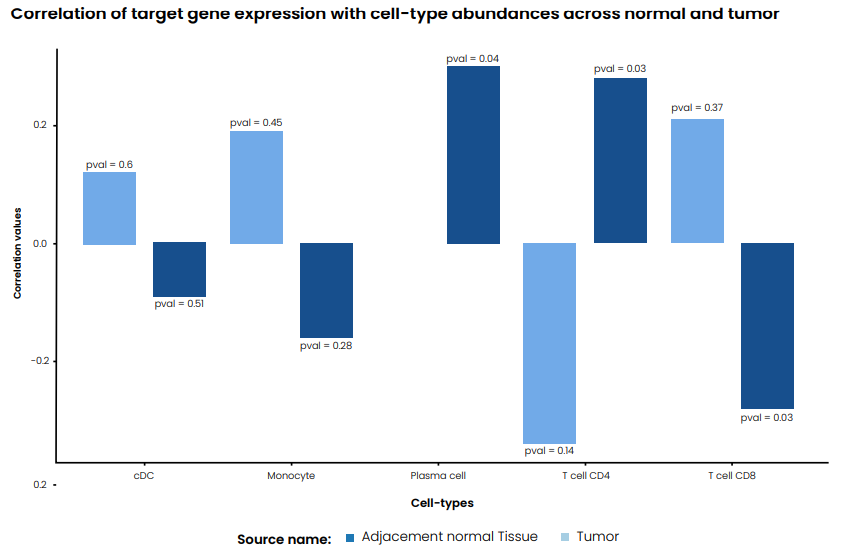
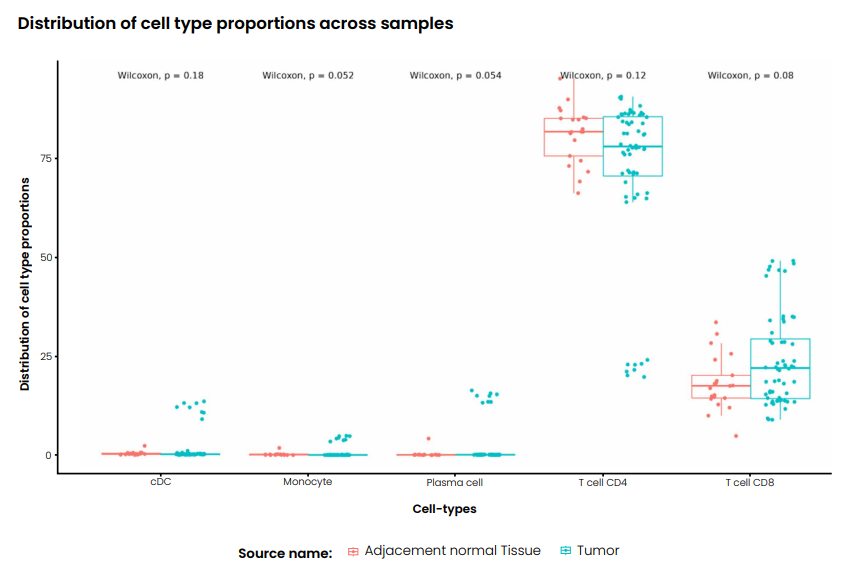
Cell annotation was performed across single-cell datasets followed by correlation analysis between immune cell abundances and target gene expression.
The analysis revealed whether increased target expression correlated with immune cell populations within the TME, indicating potential involvement in tumor remodeling processes
Region of interest (ROI) analysis
Excelra applied an innovative ROI-based spatial transcriptomics approach:
- Within-ROI comparisons analyzed high vs. low target expression within individual tissue regions.
- Across-ROI comparisons evaluated differences between spatial regions across tissue slices.
- Differentially expressed genes (DEGs) were identified for each cell type and cancer context.
The diagram on page 2 of the case study illustrates how ROI-level comparisons enabled understanding of gene influence on neighboring cells within tumor tissue
Molecular signature & cytokine analysis
DEGs identified across ROIs were further classified to identify cytokine signatures and molecular pathways affected by the target gene, strengthening mechanistic understanding at both cellular and molecular levels.
Our solution
Excelra delivered an integrated spatial and single-cell transcriptomics analysis framework.
Key Outcomes
- Mining and processing of spatial transcriptomics and scRNA-seq datasets across cancer types.
- Identification of immune cell populations associated with target gene expression.
- ROI-based spatial comparisons revealing molecular differences between tumor regions.
- Discovery of gene and cytokine expression differences across cancer contexts.
- Deployment of Excelra’s Single Cell Browser platform enabling interactive exploration of processed datasets.
Visual analyses (page 3 charts) demonstrated correlations between target gene expression and immune cell abundance across tumor and adjacent tissues, validating biological relevance of findings.
Key benefits
-
Actionable insights
Using Excelra’s advanced data mining and visualization expertise supported by Visualization Services, the client gained actionable understanding of TME biology.
-
Enhanced understanding
The analysis clarified how the target gene impacts immune cell behavior and molecular signaling pathways within tumors.
-
Guided therapeutic strategy
Findings provided direction for future oncology drug development and biomarker-driven therapeutic design aligned with biomarker applications.

Conclusion
This case study demonstrates how combining spatial transcriptomics and single-cell RNA sequencing enables deep characterization of tumor microenvironments even in the absence of traditional experimental models.
Through advanced bioinformatics, scientific informatics, and AI-enabled analytics, Excelra successfully uncovered spatially resolved gene activity patterns that inform immunotherapy strategy and precision oncology research.
The engagement highlights Excelra’s capabilities across:
- Spatial omics analytics
- Single-cell transcriptomics
- Computational biology
- Scientific data management
- AI-driven oncology discovery
Learn more about Excelra’s AI-enabled life sciences solutions at Excelra for AI or connect with our experts.