
Overview
This case study highlights Excelra’s expertise in disease indication prioritization for drug discovery programs. A mid-sized biopharmaceutical company partnered with Excelra to evaluate and expand the indication profile of a promising neurodegenerative and neuroinflammatory inhibitor. By leveraging bioinformatics solutions and advanced scientific informatics, Excelra enabled data-driven decision-making to identify the most relevant disease indications for further preclinical investment.

Our client
The client is a mid-sized biopharmaceutical company based in North America, actively developing next-generation inhibitors targeting neurodegenerative and neuroinflammatory diseases. With a molecule already in the preclinical stage, the organization sought robust scientific informatics services to guide strategic expansion into additional disease indications.

Client’s challenge
Initiating new preclinical programs requires significant financial and scientific commitment. The client needed a comprehensive, unbiased assessment of neurodegenerative and neuroinflammatory indications to determine which could be most effectively addressed by their target inhibitor. Traditional manual evaluation methods were insufficient to handle the scale and complexity of available research and clinical data, limiting effective disease indication prioritization and increasing the risk of suboptimal decision-making.

Client’s goals
The primary goal was to identify and prioritize disease indications that demonstrated strong biological relevance to the target pathway of the inhibitor. The client aimed to generate a structured biomarker-disease dataset and apply quantitative analytics to support objective disease indication prioritization. This would allow informed selection of indications with the highest translational potential while minimizing risk.
Our approach
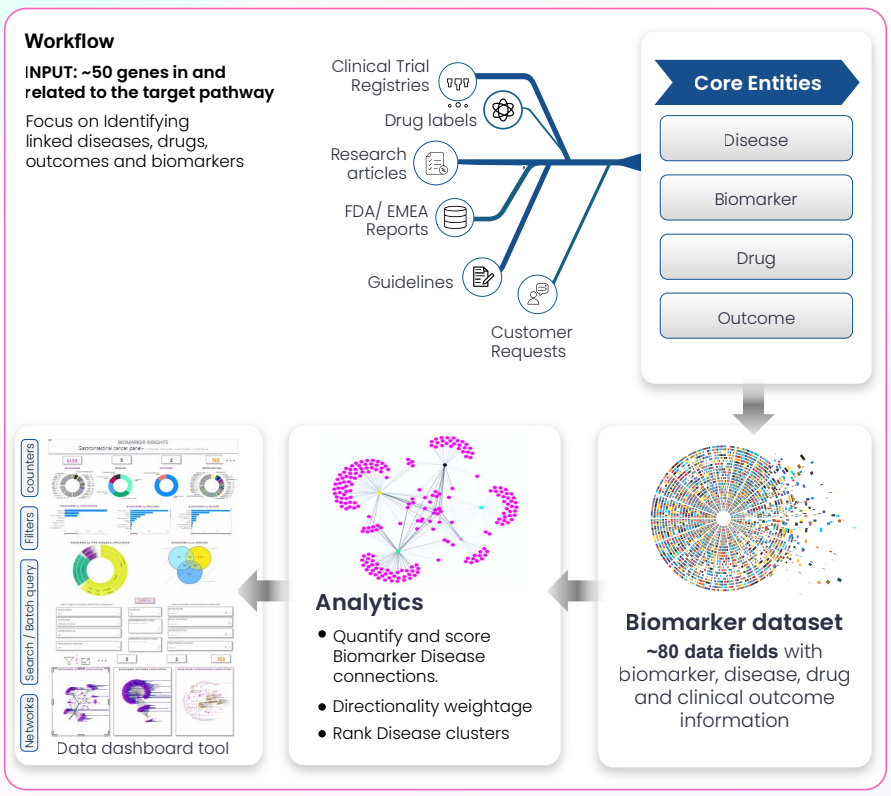
Excelra applied a target-centric, data-driven methodology supported by extensive data curation and analytics. Using insights derived from public databases, research articles, drug labels, and clinical guidelines, we built a comprehensive biomarker landscape. This approach aligned with scientific data curation best practices and minimized manual bias through quantified scoring models.
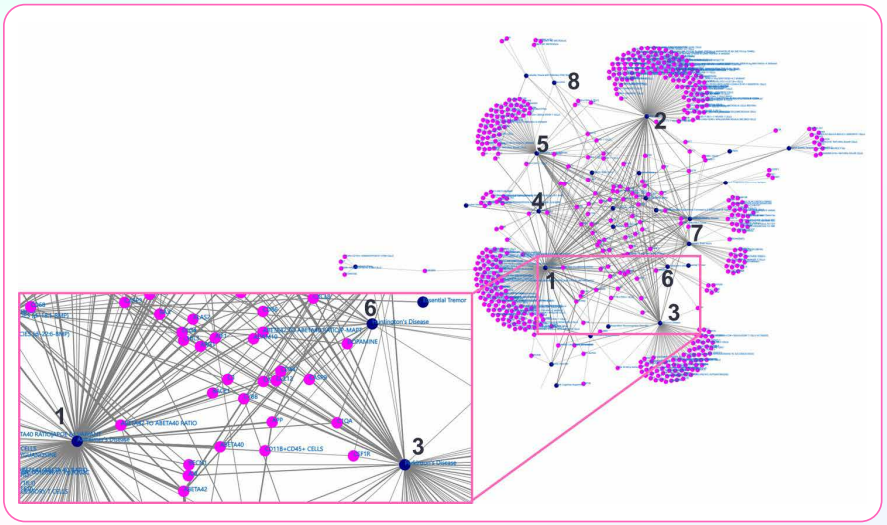
Biomarkers were evaluated based on number, directionality, specificity, and strength of association with disease pathways. Advanced analytics enabled ranking of disease clusters, while interactive visual networks allowed exploration of relationships between biomarkers, diseases, drugs, and clinical outcomes—reinforcing robust disease indication prioritization.

Our solution
Excelra delivered a structured biomarker data asset containing nearly 80 curated data fields spanning biomarkers, diseases, drugs, and clinical outcomes. A proprietary dashboard enabled interactive visualization and navigation of disease-biomarker networks. Built using scalable data science and analytics workflows, the solution empowered the client to continuously explore and refine insights beyond project completion.
Result
The analysis enabled prioritization of 45 neurodegenerative and neuroinflammatory disease indications, with the top 20 ranked by disease-target relevance scores. The client received both tabular outputs and interactive network visualizations, supporting strategic evaluation of disease clusters and biomarker enrichment patterns. This significantly strengthened confidence in downstream research planning and optimized resource allocation.

Conclusion
This engagement demonstrates Excelra’s ability to deliver unbiased, scalable disease indication prioritization using biomarker-driven analytics. By combining deep domain expertise, structured data assets, and visualization platforms, Excelra enabled informed expansion of the client’s inhibitor development strategy. The approach provides a strong foundation for future preclinical and clinical translation supported by bioinformatics and scientific informatics solutions.