
Overview
As genomic data volumes continue to grow, healthcare institutions increasingly require scalable and secure cloud environments to support high-throughput analysis. In this case study, Excelra partnered with an EU-based healthcare organization to enable cloud deployment and integration of a whole-exome pipeline. By leveraging cloud enablement services and secure scientific computing practices, the solution accelerated genomic workflows while ensuring compliance, data protection, and operational efficiency.

Our client
The client is a healthcare institution based in the EU focused on genomics-driven research and clinical insights. Their workflows involved large-scale whole-exome sequencing (WES) data generated directly from sequencers, requiring secure ingestion, scalable processing, and long-term storage. To support this, the organization sought robust bioinformatics solutions and cloud-native scientific infrastructure capable of meeting healthcare data security and compliance requirements.

Client’s challenge
The client faced limitations with on-premise infrastructure, including scalability constraints, prolonged analysis timelines, and high operational costs. Migrating a university hospital–optimised whole-exome pipeline to the cloud required secure data transfer, containerization, version-controlled pipelines, and region-restricted access. Ensuring compliance with healthcare data regulations and implementing reliable scientific data management across the entire data lifecycle were critical challenges.

Client’s goals
The primary objective was to deploy a secure, high-performance cloud environment for whole-exome sequencing analysis. The client aimed to optimize pipeline execution, reduce time-to-result, and enable scalable genomic processing using modern cloud-based pipeline orchestration. Additional goals included implementing strict access controls, supporting reproducible workflows, and ensuring long-term genomic data retention.
Our approach
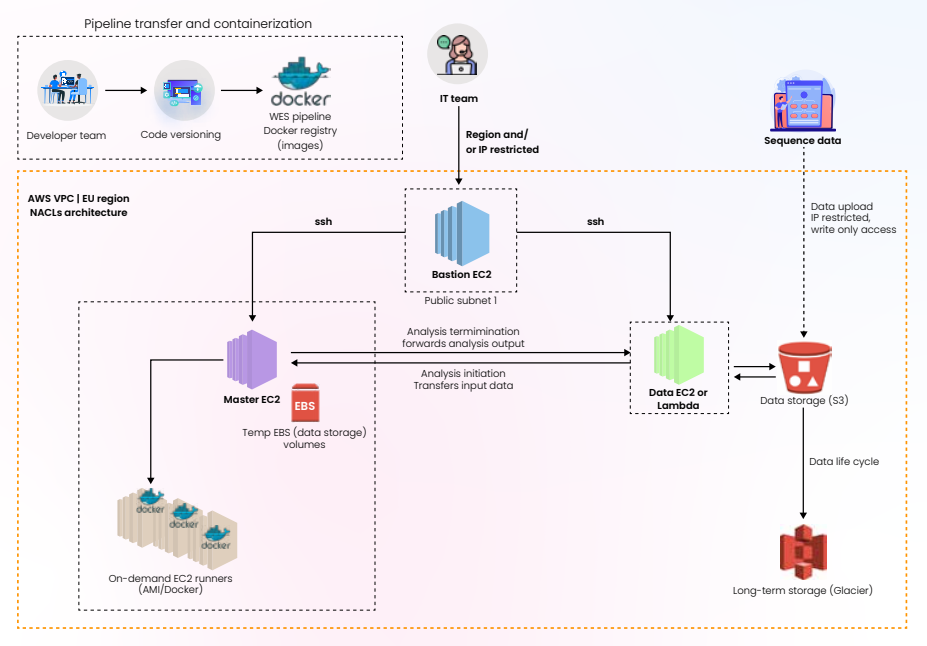
Excelra implemented a secure HPC-enabled EU cloud architecture using isolated virtual private subnets and network access control lists. Genomic pipelines were containerized and versioned via shared GitHub repositories, enabling reproducibility and controlled deployment. Direct data uploads from sequencers were supported through secure ingestion mechanisms, while lifecycle policies enabled efficient storage management using cloud-native services aligned with scientific informatics best practices.
Our solution
Excelra delivered a fully integrated cloud solution for whole-exome analysis, leveraging scalable compute resources and automated pipeline execution. The architecture enabled faster analysis, reduced operational costs, and improved data security through region-restricted access and encrypted storage. Built on the Excelra Cloud Solution, the implementation supported downstream bioinformatics workflows, long-term genomic data storage, and seamless integration with existing healthcare research systems.
Result
The optimized cloud deployment resulted in up to four-fold faster genomic analysis at lower infrastructure costs. The client achieved a highly secure computing environment, improved scalability for peak workloads, and reliable management of genomic data lifecycles. These improvements significantly enhanced throughput and reduced turnaround time for whole-exome sequencing analysis.

Conclusion
This case study demonstrates Excelra’s expertise in delivering secure, scalable cloud deployment and integration of whole-exome pipelines for healthcare genomics. By combining cloud enablement, bioinformatics expertise, and scientific informatics solutions, Excelra enabled the client to accelerate genomic insights while maintaining compliance and data integrity. Learn more about Excelra’s capabilities in cloud enablement for life sciences and bioinformatics services.