

Authors: Shawani Shome (Scientific Systems Analyst)
Over the past several years, there has been extensive investment on behalf of various scientific organizations to implement digitization in their laboratories — from deploying ELN and LIMS platforms to adopting cloud-based scientific data management systems.
Still, however, there is one basic yet unexplored question that needs to be asked:
Are scientists leveraging the potential of their data or simply capturing it better?
In most scenarios, it would appear the latter.
Modern scientific research and development laboratories generate huge volumes of data each day — from compound screening results and genomics outputs to clinical trial datasets and assay records. However, most of this data goes unused because it lacks the context and structure to become reusable in further analysis. Poor scientific data governance and fragmented infrastructure remain key blockers to unlocking value.
The realization of this need for change is just beginning to dawn in the field — the shift from simple data capture to data products.
What exactly are data products in scientific research and development?
While data products may seem like datasets at first glance, they are much more than that. They are assets created to serve a specific purpose while being reusable at the same time — a concept increasingly central to modern scientific informatics strategy.
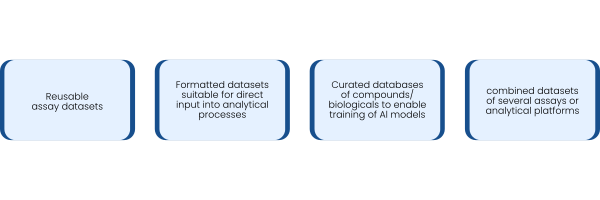
In a lab setting, data products would include:
Unlike raw experimental data, data products are:
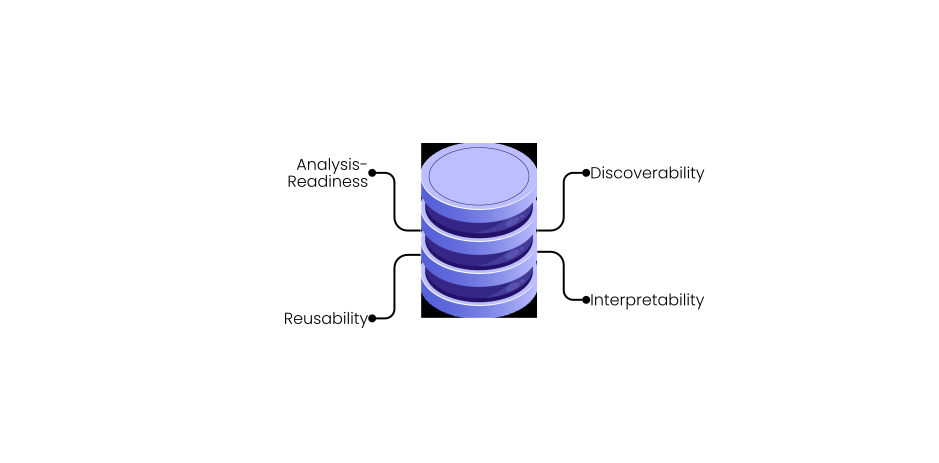
Data products are created with end use case in mind — not simply to document the experiment, but to enable the next one. This is the foundation of a true lab informatics transformation.
To understand how leading organizations are implementing this shift in practice, explore our Lab Informatics Implementation guide — a practical roadmap for moving from legacy systems to data-product thinking.
Why traditional data capture is insufficient
Current lab informatics initiatives typically address three areas:
- Data capture of experiments
- Compliance requirements
- Traceability
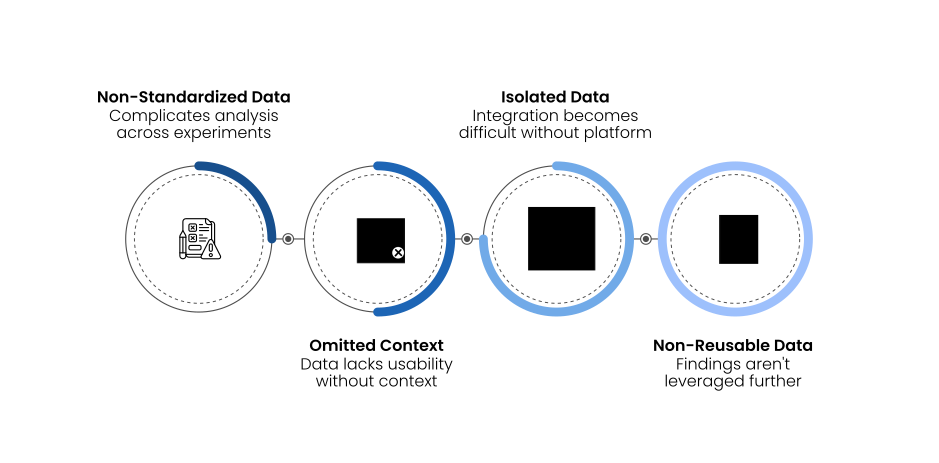
While crucial, this approach often falls short of enabling true value creation.
Our whitepaper on Data Readiness for Drug Discovery dives deep into how organizations can assess and improve their data readiness posture before launching AI or ML initiatives.
The shift: designing data as a product
For organizations to derive true value from data, they must consider a new approach to its creation and management — one rooted in scientific informatics consulting principles. Rather than ask:
“How do we document this experiment?”
The question becomes:
“How can this data be reused, aggregated, and used in future experiments?”
The result is a data-product mentality that begins in the laboratory setting. It means designing every data element with downstream consumers in mind — whether that consumer is a machine learning model, a regulatory reviewer, or a cross-functional research team working on data-driven drug repurposing.
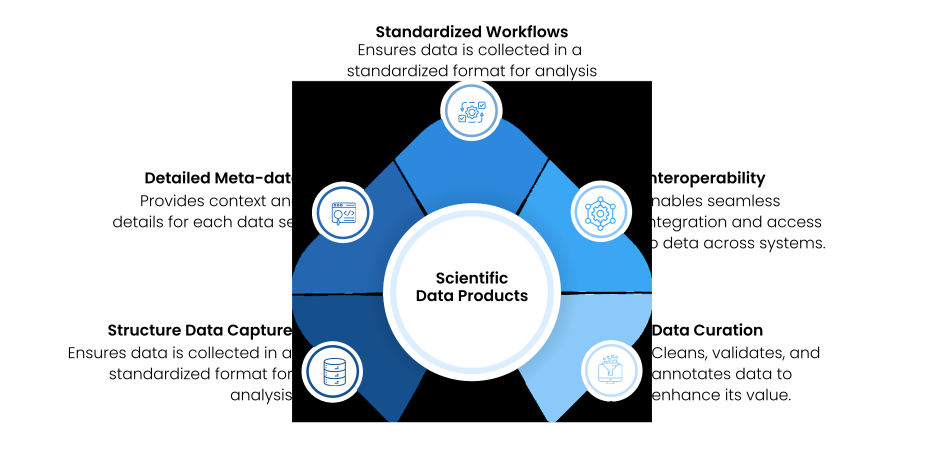
Key components of scientific data products
Why this shift matters more than ever
The convergence of artificial intelligence, multi-omics integration, and advanced computational biology services is fundamentally changing what scientific data can do. Labs that have invested in data-product thinking are now seeing compounding returns: their historical data becomes a strategic asset, not just an archive.
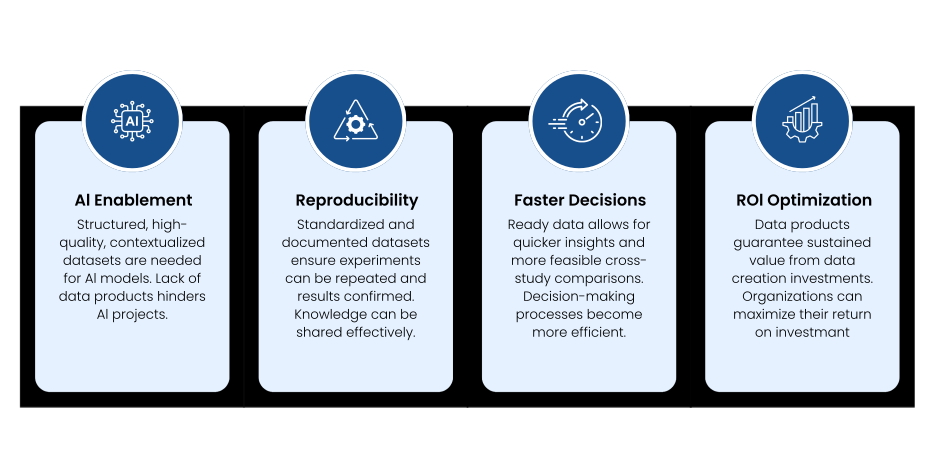
See how Excelra applied this approach in a real-world context: AI-Powered Cancer Cohort Pipeline Case Study — a demonstration of how curated, AI-ready data can accelerate oncology research timelines significantly.
Where many organizations encounter challenges
Even though companies recognize the significance of transitioning to a scientific data management model centered on data products, they often encounter real obstacles:
- Absence of standardized data models: Without common schemas, every dataset becomes a bespoke artifact that cannot be reused
- Fragmented infrastructure: Disconnected ELN, LIMS, and analytical platforms prevent seamless data flow — a challenge addressable through robust ELN LIMS integration and consulting
- Insufficient data governance strategies: Without clear ownership and lifecycle policies, data quality degrades over time
- Inadequate attention to data curation: Raw data without annotation or quality scoring is rarely usable for downstream analytics or AI applications
- Disparity between informatics professionals and scientists: Lab scientists and data engineers often speak different languages, leading to systems that capture data but don’t enable science
Here lies the significance of having a specialized scientific informatics collaborator who bridges all three worlds: science, data, and technology. Organizations investing in the right lab informatics experts today are building data infrastructure that will deliver compounding returns for years to come.
Many organizations begin this journey by assessing where they currently stand. Our Data Landscape Assessment in Pharma blog outlines a proven framework for identifying gaps in your scientific data ecosystem and prioritizing the highest-impact improvements.
Facilitating the shift: The role of informatics partners
Transforming data into data products cannot be accomplished with tools alone — it demands the expertise of science, data, and technology, working in concert. The best scientific informatics consulting partners bring all three to the table.
Organizations require assistance in:
- Developing well-structured processes and reusable protocols that encode scientific knowledge into data workflows — not just documentation
- Creating solid data models tailored to scientific requirements — whether for small molecule compound screening, biologics, genomics, or clinical data
- Integrating various systems for efficient data flow — ELN, LIMS, SDMS, analytical platforms, and cloud environments — through expert ELN LIMS consulting and scientific IT services
- Creating data governance and standardization solutions — including metadata standards, data dictionaries, and FAIR data principles in life sciences frameworks
- Curating and enhancing datasets for analysis and machine learning — transforming raw experimental output into AI-ready scientific data products
Excelra’s Scientific Informatics Services page details how we help organizations at every stage of this journey — from strategy and architecture through implementation and managed operations.
Excelra: Your partner in turning scientific data into data products
Here’s where organizations like Excelra come into play.
Having substantial experience in scientific informatics and workflow design, Excelra assists labs in moving beyond mere digitization and adopting a true data-product approach to R&D research. Our team brings together deep expertise in lab informatics implementation, data curation, cloud infrastructure, and AI-enablement — delivered through tailored scientific informatics consulting engagements.
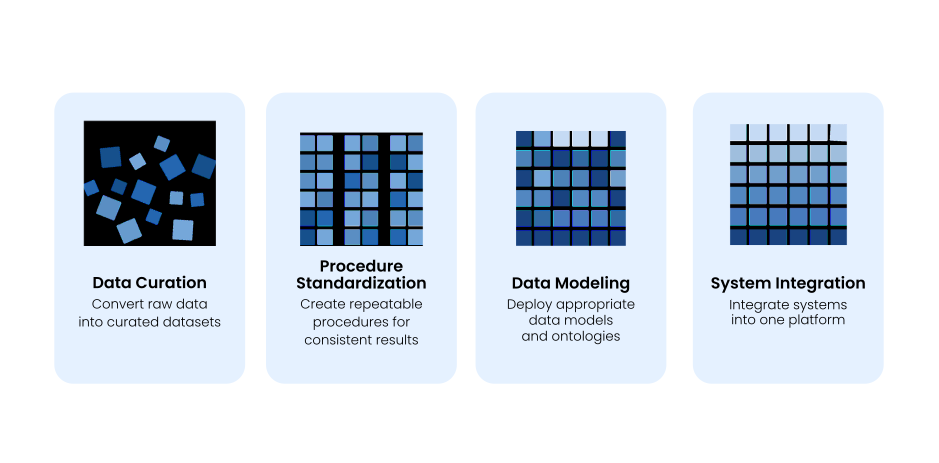
The result is not just better scientific data management — but data that actively drives discovery, accelerates drug discovery timelines, and creates a compounding competitive advantage.
Curious about how Excelra’s AI capabilities complement our informatics work? Read more about AI Agents in Life Sciences — exploring how intelligent automation is reshaping how labs interact with their data products at scale.
Conclusion: From storage to strategy
What determines the future of scientific R&D is not the amount of data created — but its effectiveness of use.
Transitioning from data acquisition to data products implies a revolutionary change in how labs think about scientific data management:
- From storage to strategy
- From experiments to reusable knowledge
- From isolated data to connected, AI-ready insights
Companies willing to adopt this data-product mindset will benefit not only from increased efficiency — they will generate more innovative ideas, enable greater cross-functional collaboration, and unlock artificial intelligence applications across the R&D value chain.
This is because today, in scientific R&D, data is not merely an output — it is a product.
And like any product, it deserves to be designed, curated, governed, and evolved with intention.
What is a data product in scientific research?
A data product in scientific research is a curated, structured, and reusable dataset built with a specific downstream purpose in mind — such as training an AI model, supporting regulatory submission, or enabling cross-experiment comparison. Unlike raw experimental data, a scientific data product is enriched with metadata, quality flags, and provenance information, and is governed under FAIR data principles (Findable, Accessible, Interoperable, Reusable). It is designed to deliver ongoing value across multiple use cases, not just document a single experiment.
How is a data product different from a dataset in a lab?
A traditional lab dataset is created as a byproduct of an experiment — it captures what happened. A data product, by contrast, is designed before or during the experiment with reuse in mind. It includes standardized schemas, metadata, quality scores, and data lineage documentation. Think of a dataset as raw material and a data product as a finished good: structured, documented, and immediately usable by the next consumer — whether that’s a scientist, a machine learning model, or a regulatory reviewer.
Why is scientific data management important for drug discovery?
Effective scientific data management is critical for drug discovery because the speed and accuracy of identifying viable drug candidates depends on the quality of the underlying data. When data is captured in inconsistent formats, stored in siloed systems, or stripped of experimental context, it cannot be aggregated or used to train predictive models. Organizations with mature scientific data management practices — including FAIR data governance and curated compound screening datasets — are able to run AI-powered analyses that dramatically accelerate target identification and compound optimization.
What are the biggest challenges in lab informatics transformation?
The most common challenges include: (1) absence of standardized data models across instruments and departments; (2) fragmented ELN, LIMS, and SDMS infrastructure that prevents seamless data flow; (3) weak data governance — no clear ownership, versioning, or quality policies; (4) insufficient data curation practices, leaving datasets without the annotation needed for downstream use; and (5) a skills gap between scientists and informatics professionals. Addressing these requires a combination of strategy, the right technology stack, and experienced scientific informatics consulting partners.
What is FAIR data and why does it matter for scientific labs?
FAIR data refers to datasets that are Findable, Accessible, Interoperable, and Reusable — a set of guiding principles established to improve the value and reuse potential of scientific data. In a lab context, applying FAIR data principles means ensuring that every dataset has a unique identifier, is described with rich metadata, uses standardized formats and vocabularies, and is stored with clear access permissions. FAIR compliance is increasingly a requirement for regulatory submissions, grant funding, and AI/ML readiness — making it a cornerstone of any serious scientific informatics strategy.
How can a scientific informatics partner help with data products?
A scientific informatics partner like Excelra brings together domain expertise in life sciences, data engineering, and technology architecture to help organizations design and implement a data-product strategy. This includes assessing the current data landscape, designing standardized data models, integrating ELN/LIMS/SDMS platforms, implementing data governance frameworks, and curating datasets for AI and analytics applications. The result is a scalable data infrastructure that turns every experiment into a reusable scientific asset.
Ready to Build Your Scientific Data Products?
Excelra helps pharmaceutical, biotech, and life sciences organizations transform their laboratory data into strategic, reusable data products. Whether you're starting with a data landscape assessment, modernizing your ELN/LIMS stack, or building AI-ready data pipelines, our scientific informatics experts are ready to help.