

Author: Prabhu Pandian (Enterprise Architect, Scientific Informatics)
What are AI agents?
AI agents in life sciences are increasingly used to automate complex, goal-driven tasks that traditionally required significant human effort. These agents operate autonomously across systems, using large language models (LLMs) to make decisions, interact with tools, and adapt to evolving requirements.
Within modern research environments, AI agents in life sciences play a critical role in enabling scalable and intelligent scientific informatics workflows that reduce manual effort and improve consistency across data-driven processes.
Key use cases of agentic AI in life sciences include:
- Streamlining drug discovery by automating literature review, hypothesis generation, and data curation
- Automating content creation for structured documents such as regulatory products, protocols, and scientific reports
- Driving regulatory compliance through intelligent tracking of submission requirements, validation rules, and documentation consistency
- Enhancing competitive intelligence by summarizing insights from internal and external data sources
- Assisting medical affairs with automated response generation, KOL profiling, and knowledge dissemination
Why are AI agents important?
Consider a scenario in the life sciences domain where a user needs to search for research papers related to oncology and neurology. Traditionally, this involves navigating a vast inventory of documents—similar to finding the right book in a massive library—making the process time-consuming and error-prone.
While Generative AI can assist by understanding natural language queries and summarizing content, AI agents take this a step further. They autonomously search across multiple sources, refine queries, filter relevant documents, and return structured insights. This enables intelligent, AI-driven workflows that significantly accelerate research and decision-making across digital transformation initiatives in life sciences.
Can we do this with gen AI alone? how do agents help?
Yes, this can be achieved using Generative AI alone. However, AI agents simplify and automate the process by acting as orchestration layers built on top of LLMs. Rather than working independently, agents function as frameworks that reduce repetitive development effort by managing tool invocation, API parameters, and workflow chaining.
While most AI agents rely on LLMs for reasoning, some operate using rule-based logic. However, LLM-driven agents provide greater flexibility and adaptability, particularly when applied to complex scientific domains requiring contextual awareness and AI-powered analytics.
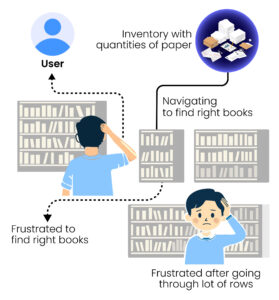
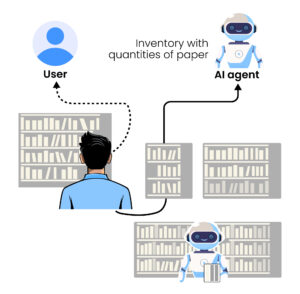
Before AI agent & After AI agent Intervene
Real-World example: AI agent in a RAG workflow
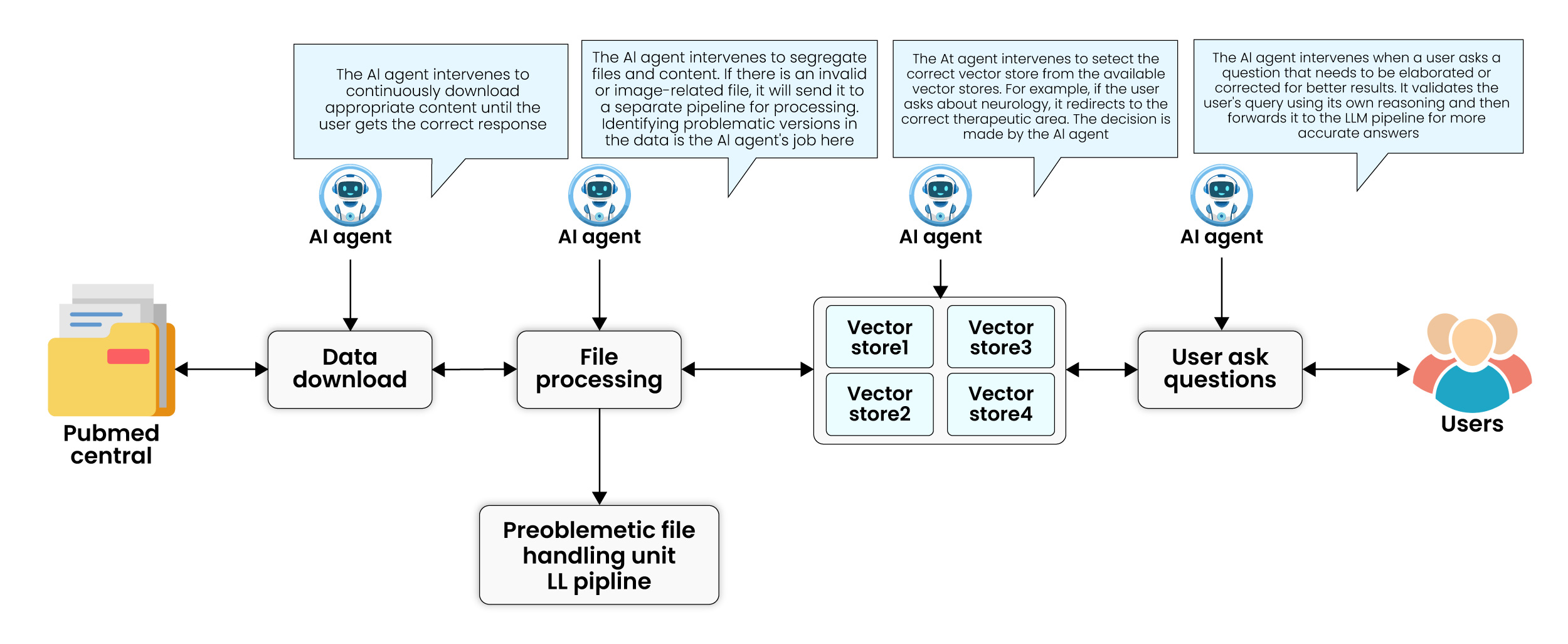
Imagine a Retrieval-Augmented Generation (RAG) model processing medical literature from sources such as PubMed. The pipeline is enhanced by AI agents at various stages:
- File discovery & download: The agent retrieves content until the correct context is identified
- Validation & segregation: Invalid or image-heavy files are routed through specialized LLM pipelines
- Source selection: The agent selects the appropriate domain-specific vector store for accurate retrieval
- Query refinement: Vague or incorrect queries are validated and refined using agentic reasoning
This orchestration ensures high accuracy, relevance, and speed in delivering scientific answers, supporting scalable AI-driven knowledge discovery.
Value delivered by AI agents
The introduction of AI agents delivers measurable value across life sciences workflows:
- Reduced human intervention: Eliminates the need for manually coding every logic step
- Contextual understanding: Queries are optimized for improved LLM responses
- Dynamic decision-making: Agents interact with predictive models to guide outcomes
- Domain specialization: Supports multiple therapeutic areas with tailored intelligence
Integration in our pipeline
We have implemented AI agents using three major frameworks:
- LangChain: Enables chaining of LLM-driven tasks and retrieval workflows
- LangGraph: Supports visual flow control with conditionals and observability
- AutoGen: Facilitates agent-to-agent collaboration and tool usage
This layered integration ensures modularity, traceability, and performance optimization across the knowledge processing lifecycle—key requirements for enterprise-grade scientific application development.
Popular AI agent frameworks in the market
Several AI agent frameworks are widely adopted to support intelligent workflows:
- AutoGen – Multi-agent conversations with memory for collaborative workflows
- Auto-GPT – Autonomous task-driven execution
- Ray – Distributed computing for scalable AI workloads
- OpenAI Gym – Reinforcement learning experimentation environments
- Semantic Kernel – Enterprise-grade AI orchestration
- Haystack – Production-ready RAG framework
- LangChain – General-purpose agent and RAG framework
- LlamaIndex – Optimized document indexing and retrieval
- LangGraph – Stateful, graph-based agent workflows
Final thoughts
AI agents are transforming how organizations interact with and extract insights from data. In life sciences, where accuracy and speed are critical, AI agents in life sciences provide the autonomy, intelligence, and scalability required to stay ahead.
By combining reasoning, decision-making, and seamless LLM integration, AI agents are not just tools—they are intelligent collaborators that accelerate innovation across modern life sciences research and development.