
Overview
This case study demonstrates how Excelra enabled AI biomarker discovery for psoriasis to support personalized treatment strategies for a leading European pharmaceutical company. By applying advanced bioinformatics solutions, artificial intelligence, and machine learning, Excelra helped uncover patient-specific biomarkers that predict therapeutic response to Cosentyx (Secukinumab), enabling data-driven precision medicine.

Our client
The client is a leading pharmaceutical company based in Europe with a strong focus on immunology and autoimmune diseases. With Cosentyx established as a successful therapy for psoriasis, the organization sought to enhance treatment outcomes through personalized medicine approaches supported by precision medicine and scientific informatics.

Client’s challenge
Traditional biomarker identification relied heavily on manual analysis of large, heterogeneous clinical trial datasets, making the process time-consuming, error-prone, and subjective. These limitations restricted the ability to uncover hidden patterns in patient response data and hindered consistent biomarker identification. To overcome these challenges, the client required a scalable, objective, and data-driven approach to AI biomarker discovery for psoriasis.

Client’s goals
The primary objective was to identify robust, patient-specific biomarkers capable of predicting response to Cosentyx therapy. The client aimed to leverage AI and ML techniques to improve treatment personalization, optimize clinical trial design, and strengthen decision-making across drug development workflows supported by scientific informatics services.
Our approach
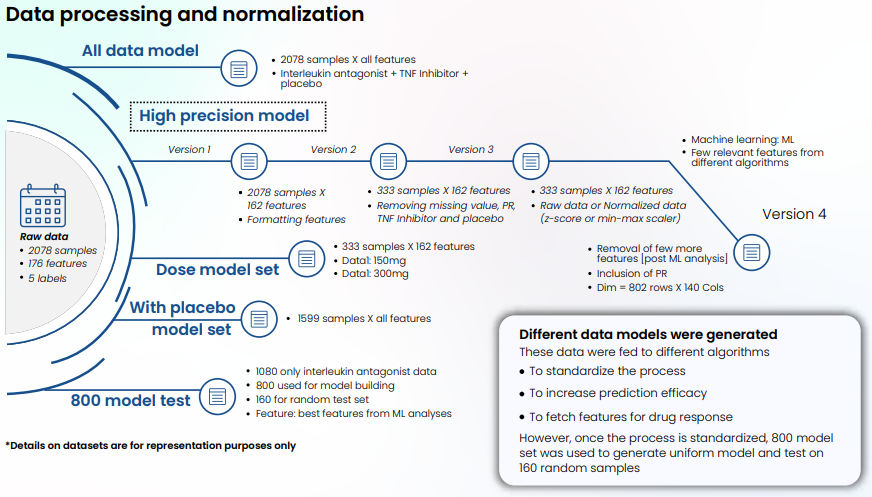
Excelra partnered closely with the client’s scientific teams to design a multi-stage AI-driven workflow. We began with rigorous data preprocessing, cleaning, and normalization of heterogeneous clinical trial data, including clinical parameters, blood diagnostics, and genetic features. Principal Component Analysis (PCA) was applied to understand data structure and eliminate batch effects.
Multiple AI/ML algorithms were evaluated across several data models to identify optimal feature sets. Confounding factor analysis was incorporated to isolate drug-specific signals from placebo effects, ensuring accurate AI biomarker discovery for psoriasis. Identified biomarkers were further validated against known disease mechanisms and drug modes of action, aligning with FAIR data principles and best practices in biomedical analytics.
Our solution
Excelra delivered a validated set of biomarkers spanning clinical, hematological, and genetic categories. Using advanced data science and analytics, the solution identified 21 features associated with therapeutic efficacy, including novel genotypes and SNPs that open new avenues for research. The approach provided a comprehensive, interpretable framework for patient stratification and treatment optimization.
Result
The AI-driven workflow significantly reduced analysis time compared to traditional methods while uncovering deeper biological insights. Nine biomarkers showed strong evidence linking them to disease progression and Cosentyx’s mechanism of action, while four novel genetic features emerged as potential future research targets. These outcomes reinforced the value of AI biomarker discovery for psoriasis in supporting personalized therapy and clinical trial refinement.


Conclusion
This collaboration highlights how AI and ML can transform biomarker discovery and patient stratification in autoimmune diseases. By integrating advanced analytics, bioinformatics, and scientific data management, Excelra enabled personalized psoriasis treatment strategies grounded in data-driven evidence. The success of this project underscores Excelra’s capability to accelerate precision medicine initiatives through scalable bioinformatics and AI-powered solutions.