
Overview
Immunotherapy has transformed cancer treatment by enabling targeted immune responses against tumors. However, variability in patient response remains a major challenge, often leading to ineffective treatment outcomes and increased risk of adverse effects. Leveraging AI-powered patient stratification and advanced bioinformatics solutions delivered through Excelra’s Bioinformatics Services and Scientific Informatics capabilities, Excelra developed a data-driven approach to accurately identify patients most likely to benefit from immunotherapy, supporting precision medicine initiatives and improved clinical decision-making.

Our client
Our client is a California-based pharmaceutical company focused on developing innovative immunotherapy drugs for cancer treatment. The organization is committed to improving therapeutic effectiveness through advanced research and clinical innovation supported by modern digitization and data science in drug discovery approaches but faced challenges in accurately selecting suitable patients for immunotherapy interventions.

Client’s challenge
A leading California-based pharmaceutical company developing immunotherapy drugs faced a critical challenge: identifying the most suitable patients for their therapy. Immunotherapy is promising in treating various cancers, but patient response can vary greatly. Accurately classifying patients who would benefit most from the therapy is crucial for maximizing treatment effectiveness and minimizing side effects.
Traditionally, patient selection relied on broad clinical factors, leading to suboptimal outcomes. The client sought a more precise approach aligned with modern AI & Machine Learning solutions and advanced Clinical Data Services to identify ideal candidates for their immunotherapy treatment.

Client’s goals
The client aimed to develop a robust and efficient method for classifying patients into two distinct groups:
By achieving this goal, the client hoped to:
- Responders: Patients most likely to experience a positive response to the immunotherapy treatment.
- Non-responders: Patients unlikely to benefit from the treatment and potentially at risk of side effects.
By achieving this goal, the client hoped to:
- Improve treatment efficacy: Matching the right patients to the right therapy would lead to better overall treatment outcomes supported by AI-driven precision medicine strategies.
- Reduce side effects: Minimizing unnecessary administration of the therapy would decrease the risk of adverse reactions in non-responding patients.
- Optimize clinical trials: A more precise selection process could streamline trials using structured datasets similar to approaches described in analysis-ready clinical datasets.
Our Approach
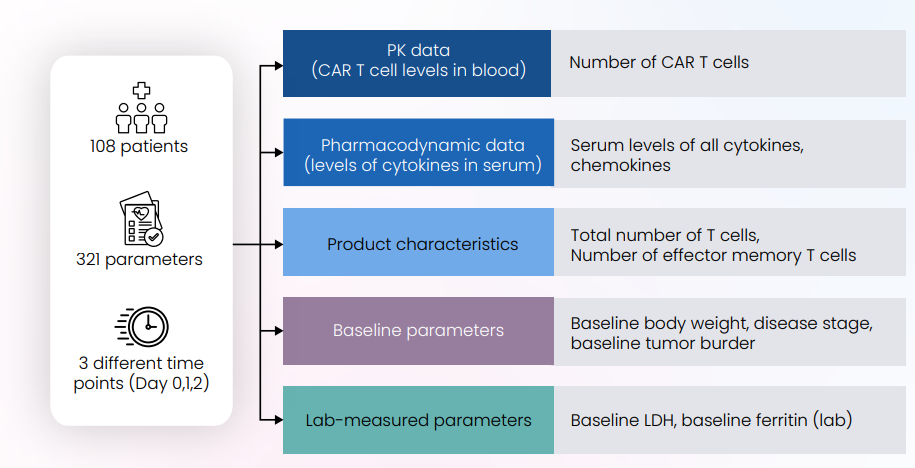
Excelra partnered with the client to leverage artificial intelligence (AI) and machine learning (ML) for patient stratification, combining expertise from Data Science Services and Scientific Data Management.
- Data Preparation: We meticulously cleaned, normalized, and integrated complex patient data from various sources, including electronic health records, genomic data, and clinical trial data.
- Feature Selection: We employed a robust feature selection methodology, combining multiple techniques to identify the most relevant diagnostic parameters for patient classification. This ensured the model focused on the most informative data points for accurate prediction.
- Model Building: We developed and evaluated various machine learning models using the selected features. This involved training the models on a portion of the data and testing their performance on unseen data to ensure generalizability.
- Evaluation and Model Interpretation: We rigorously evaluated the models’ performance metrics, including accuracy, sensitivity, and specificity. We also employed advanced interpretability techniques to understand how the models arrived at their classifications. This transparency provided valuable insights into the factors driving patient response.
Results
Through our collaborative efforts, we achieved significant progress in patient stratification for the client’s immunotherapy treatment:
- Highly Accurate Classification: The XGBoost model achieved an accuracy of 89% in differentiating responders from non-responders. This can lead to improved treatment efficacy and potentially reduce unnecessary side effects.
- Improved Response Identification: The XGBoost model demonstrated a sensitivity of 85%, indicating it can correctly identify 85% of patients who will respond positively to the immunotherapy treatment.
- Reduced False Positives: The model achieved a specificity of 90%, meaning it can accurately exclude 90% of patients unlikely to benefit from the therapy, potentially minimizing unnecessary side effects.


Conclusion
This case study demonstrates the power of AI and machine learning in transforming patient stratification for immunotherapy. By leveraging Excelra’s expertise across life sciences services, advanced analytics, and scientific informatics, our client gained a powerful tool to personalize treatment decisions and improve patient outcomes.
- Highly Accurate Classification: The final model achieved a high degree of accuracy in differentiating responders from non-responders. This paves the way for confident patient selection in clinical trials and real-world settings.
- Actionable Insights: The model interpretation techniques revealed key diagnostic parameters associated with treatment response. These insights can inform the development of companion diagnostics to further refine patient selection.
- Streamlined Clinical Trials: The ability to identify ideal candidates can significantly accelerate and optimize clinical trials by focusing on the most responsive patient
populations.
Looking to leverage AI for patient selection in your clinical trials?
This case study demonstrates the power of AI and machine learning in transforming patient stratification for immunotherapy. By leveraging Excelra’s expertise in data science and machine learning, our client gained a powerful tool to personalize treatment decisions and improve patient outcomes. Excelra offers a comprehensive suite of AI-powered solutions to optimize patient stratification, accelerate clinical trial timelines, and improve treatment efficacy. Contact us today to learn how we can help you harness the power of AI for your drug development programs