
Overview
Accurate dose regulation is critical for achieving optimal therapeutic efficacy while minimizing adverse effects. In this case study, Excelra partnered with a pharmaceutical organization to implement PK/PD modeling for dose regulation, enabling data-driven assessment of drug dosage over time. By combining clinical pharmacology expertise with advanced data science and analytics, the solution supported precise treatment strategies tailored to host-specific physiological and enzymatic factors.

Our client
The client is a pharmaceutical research organization focused on improving treatment efficacy across multiple disease indications. Their research emphasized understanding pharmacokinetics and pharmacodynamics in relation to host genetics, enzyme kinetics, and physiological parameters. To support this vision, they required scalable scientific informatics solutions capable of modeling drug behavior across biological compartments.

Client’s challenge
The primary challenge was accurately determining the right drug dosage based on complex biological variables such as enzyme kinetics, multi-compartment drug distribution, and physiological differences between patients. Traditional dosing approaches lacked the precision needed for personalized treatment, limiting the ability to apply precision medicine principles and increasing the risk of suboptimal therapeutic outcomes.

Client’s goals
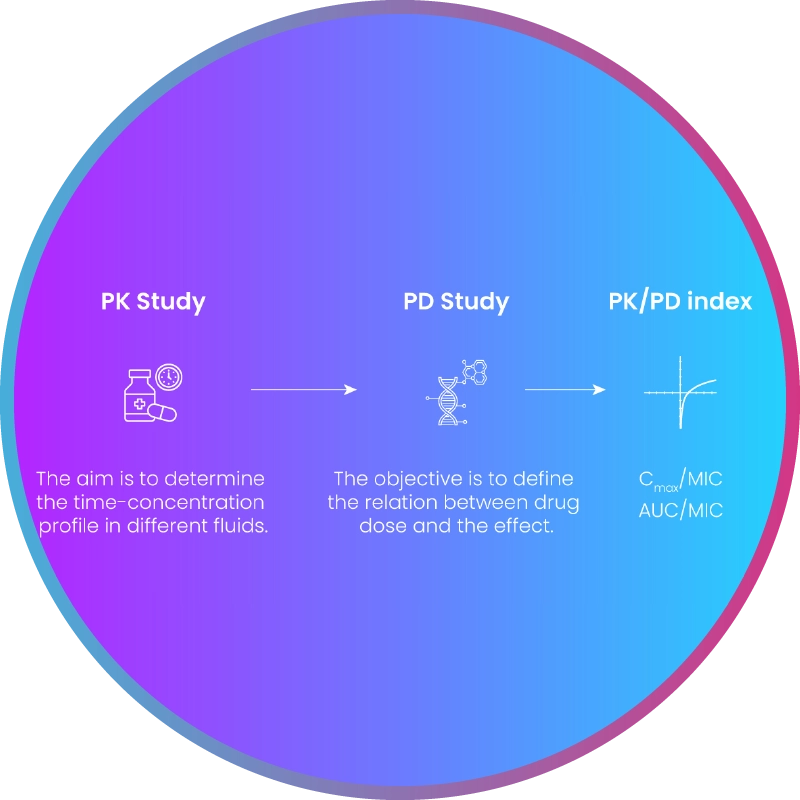
The client aimed to implement a robust PK/PD modeling framework that could assess dosage over time across key biological compartments. Their goals included improving drug efficacy, supporting treatment personalization, and enabling data-driven decisions through advanced data visualization in life sciences for pharmacokinetic and pharmacodynamic insights.
Our approach
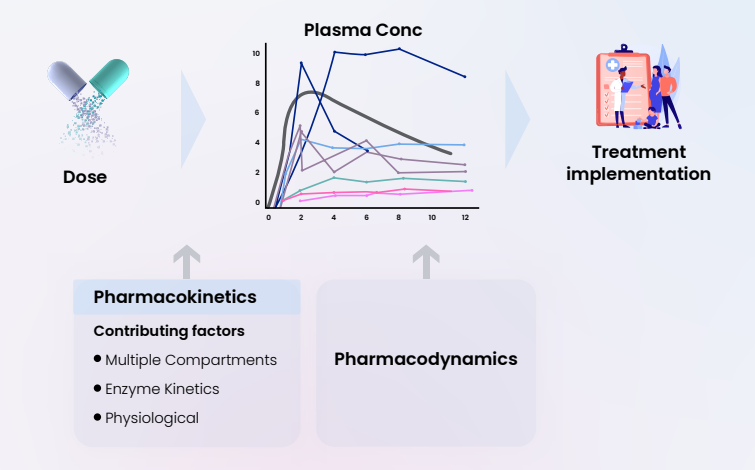
Excelra developed a structured modeling strategy grounded in pharmacokinetics and pharmacodynamics. The approach involved defining host compartments of interest, formulating enzyme kinetics equations, and integrating physiological data into dosage calculations. Differential equations were implemented to simulate dose regulation over time, ensuring accurate modeling of plasma concentration, treatment response, and contributing biological factors.
Our solution
Excelra delivered a scalable PK/PD modeling solution that integrated multi-compartment analysis, enzyme kinetics, and physiological parameters into a unified framework. The implementation enabled precise dose regulation, improved treatment efficacy, and supported advanced predictive modeling for drug response optimization. The solution was designed to align with modern data-driven drug discovery workflows.
Result
The PK/PD modeling framework enabled accurate dosage assessment based on host-specific enzyme kinetics and physiological factors. As a result, the client achieved improved therapeutic efficacy, better dose regulation across treatment timelines, and enhanced confidence in pharmacological decision-making. The approach also laid the foundation for scalable modeling strategies supporting personalized and precision-driven therapies.
Conclusion
This case study demonstrates Excelra’s expertise in applying PK/PD modeling for dose regulation to solve complex clinical pharmacology challenges. By combining advanced analytics, scientific informatics, and pharmacokinetic modeling, Excelra enabled the client to optimize drug dosing strategies and improve patient outcomes. Learn more about Excelra’s capabilities in scientific informatics services and data-driven life sciences solutions.