
Authors: Janhavi Thukkaram (Scientific Informatics Consultant)
In modern life sciences R&D, data is generated at every step — from experiments and samples to instruments and analytics. Yet without the right lab informatics systems in place, this data often becomes fragmented, inconsistent, and difficult to use for decision-making or regulatory compliance.
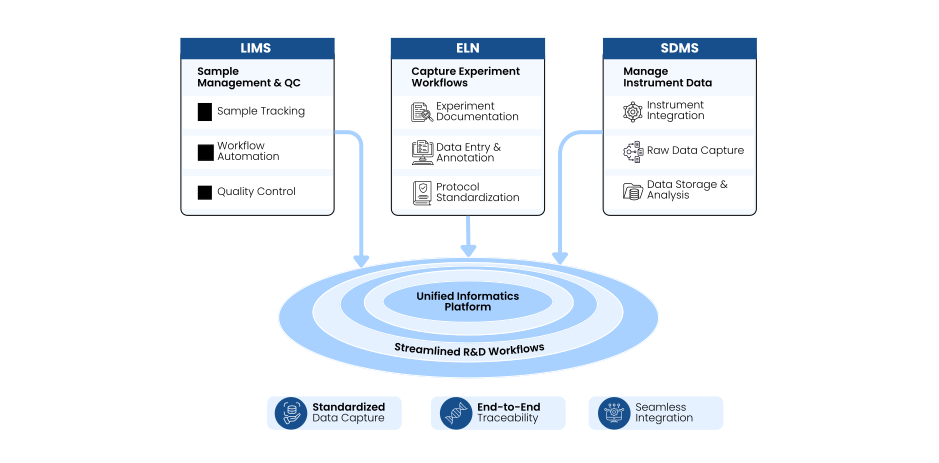
LIMS, ELN, and SDMS are the three foundational pillars of lab informatics. Understanding how they differ and how they work together is critical to enabling data-driven research and building a compliant, scalable scientific data management infrastructure.
Before diving in, it is worth noting that the question most labs face is not which system to choose — it is how to integrate all three effectively. If you are still evaluating your options, our guide on ELN vs. LIMS: Deciding the Ideal System for Your Organization provides a useful starting framework.
Understanding the core systems
LIMS (Laboratory Information Management System)
LIMS focuses on managing samples, workflows, and laboratory operations. It ensures that every sample is tracked, processed, and reported accurately — making it the operational backbone of any regulated laboratory environment. From quality control in pharmaceutical manufacturing to sample chain-of-custody in clinical diagnostics, a well-implemented LIMS is the foundation of lab data governance.
Core capabilities:
- Sample registration and tracking
- Workflow automation
- QC and compliance management
- Reporting and audit trails
Popular tools: Thermo Fisher SampleManager LIMS, LabWare LIMS, STARLIMS
Typical workflow enabled:
Sample intake → Barcode assignment → Testing → QC validation → Results reporting
For a deeper look at how LIMS fits into the broader lab informatics landscape, see our Laboratory Information Management System (LIMS) glossary entry — a concise reference for evaluating LIMS capabilities against your lab’s specific requirements.
ELN (Electronic Lab Notebook)
ELN is designed for scientists to document experiments in a structured and searchable manner. Where LIMS governs operational workflows, the electronic lab notebook governs scientific knowledge — capturing the reasoning, observations, and context behind each experiment in a way that supports reproducibility, collaboration, and knowledge retention.
Core capabilities:
- Experiment documentation
- Protocol management
- Collaboration and review workflows
- Scientific data capture and linking
Popular tools: Benchling, Dotmatics ELN, Sapio Science, IDBS
Typical workflow enabled:
Experiment design → Protocol execution → Observations capture → Data linking → Review and collaboration
Many labs struggle with the overlap between ELN and LIMS functionality. Our blog post From Clutter to Clarity: The Essential Guide to ELN and LIMS walks through how to clearly delineate responsibilities across these systems and eliminate data duplication.
SDMS (Scientific Data Management System)
SDMS acts as a centralized repository for raw and processed instrument data. While LIMS and ELN manage samples and scientific context respectively, the scientific data management system ensures that the underlying instrument outputs — chromatograms, spectra, assay readouts — are captured, preserved, and retrievable with full metadata integrity.
Core capabilities:
- Direct instrument integration and automated data capture
- Centralized data storage with version control
- Metadata preservation and tagging
- Data retrieval and search for analysis or audit
Popular tools: Waters NuGenesis SDMS, Thermo Scientific SampleManager SDMS, Agilent OpenLab
Typical workflow enabled:
Instrument data capture → Metadata tagging → Secure storage → Retrieval for analysis or audit
For a precise technical definition of SDMS and its role relative to LIMS and ELN, refer to our Scientific Data Management System (SDMS) glossary.
Key differences at a glance
The table below summarizes the primary distinctions across the three systems — a useful reference when building your lab informatics integration roadmap:
| Capability | LIMS | ELN | SDMS |
| Primary Focus | Samples and workflows | Experiments | Data storage |
| Users | Lab managers | Scientists | IT and data teams |
| Data Type | Structured | Semi-structured | Raw data |
| Compliance | High | Moderate | Moderate |
Real-World case study: Global pharma standardization
A global biopharmaceutical company operating across multiple regions faced major inefficiencies due to disconnected lab informatics systems. Each site used different tools for sample tracking, experiment documentation, and instrument data storage — creating compliance risks, data inconsistencies, and significant manual overhead.
Challenges
- Data silos across geographies with no unified view of research outputs
- Inconsistent workflows and data formats making cross-site analysis impossible
- Manual data transfers between systems, creating transcription errors and audit trail gaps
- Compliance risks due to lack of end-to-end traceability across the sample lifecycle
- Loss of metadata and experimental context during system-to-system handoffs
Solution
- Standardized on a global LIMS platform (SampleManager LIMS) across all sites
- Integrated ELN for structured experiment documentation and protocol management
- Implemented SDMS for centralized instrument data capture with automated metadata tagging
- Established unified data models and governance workflows across the informatics ecosystem
Outcome
- 40–60% reduction in manual data handling time across laboratory operations
- Significantly improved regulatory compliance posture and audit readiness
- Faster cross-site decision-making enabled by unified, real-time data access
This type of outcome — achieved through structured ELN and LIMS integration — is explored in depth in our two-part series: Overcoming Laboratory Data Chaos Part 1: The Case for ELN-LIMS Integration and Part 2: Execution, Strategy, and Results.
Real-Time example: Analytical lab workflow
Consider a typical analytical testing scenario in a pharmaceutical quality control lab — and how LIMS, ELN, and SDMS each play a distinct, non-overlapping role:
- LIMS registers the incoming sample and assigns test workflows based on sample type and testing protocol
- Laboratory instruments generate raw data — chromatograms, spectra, or assay readouts — which are automatically captured and stored in SDMS with full metadata preservation
- Scientists interpret the instrument outputs, annotate observations, and document insights in the ELN, linking data back to the originating sample record
- Results are validated against acceptance criteria and formally reported through LIMS, which maintains the complete audit trail from receipt to release
This integrated workflow eliminates manual data transfers, ensures traceability at every step, and creates a continuous, governed data chain from sample intake to final report — the foundation of a compliant and efficient lab informatics ecosystem.
What your lab really needs
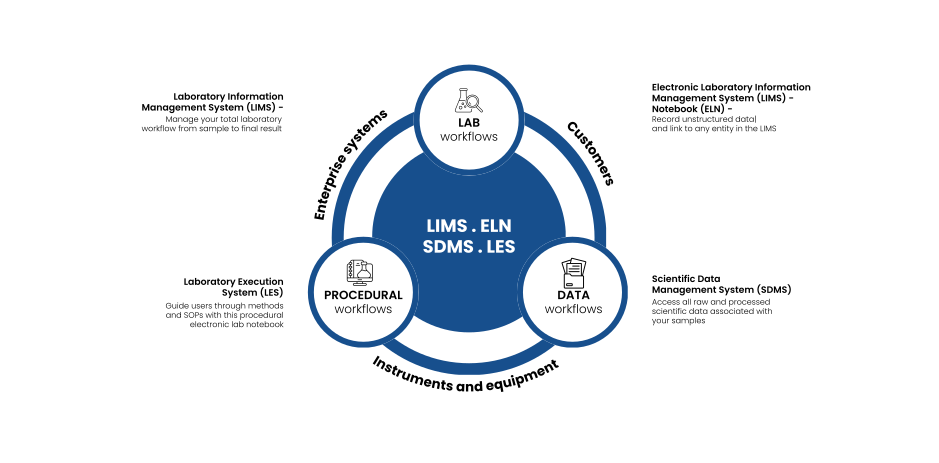
Modern labs need an integrated informatics ecosystem where LIMS, ELN, and SDMS work together seamlessly. The goal is not to implement three separate systems — it is to design a unified data architecture where each system contributes its strengths and shares data with the others without friction.
Key capabilities of a well-integrated lab informatics ecosystem:
- End-to-end data flow across LIMS, ELN, and SDMS without manual handoffs
- Real-time instrument integration ensuring raw data flows directly from instruments into SDMS
- Standardized and governed data models enabling consistent interpretation across experiments, sites, and systems
- Automated workflows and approval chains reducing manual intervention and human error
- Centralized analytics and reporting drawing on data from all three systems in a unified view
- API-driven interoperability allowing the ecosystem to connect with external platforms — CRO data systems, cloud environments, and AI and ML pipelines
The hidden cost of unintegrated lab systems goes beyond inefficiency — it directly impacts the quality of data available for AI and machine learning initiatives. Our blog on The Hidden Cost of Bad Lab Data examines why data quality is now the most critical bottleneck in life sciences R&D.
How Excelra enables this transformation
Excelra plays a critical role in helping pharmaceutical, biotech, and life sciences organizations design, implement, and integrate lab informatics ecosystems. Our scientific informatics consulting teams bring together deep expertise in LIMS, ELN, and SDMS — along with the system integration, data governance, and automation capabilities needed to make those systems work as a unified whole.
Excelra’s capabilities include:
- System Integration: Seamless integration of LIMS, ELN, SDMS, and external platforms — from CRO data ingestion systems to cloud-based analytical environments
- Data Standardization: Harmonizing data models across CROs, labs, and platforms to enable consistent interpretation and cross-site analysis
- Automation Frameworks: Reducing manual intervention through structured workflow automation across sample lifecycle, experiment documentation, and instrument data capture
- AI-driven Migration Tools: Accelerating legacy system migration with minimal data loss and disruption to ongoing laboratory operations
- Instrument Integration: Enabling direct, automated data capture from laboratory instruments into SDMS — eliminating manual file transfers and transcription errors
- Compliance Enablement: Building audit trails, validation frameworks, and role-based access control into the integrated informatics ecosystem from day one
- Custom Workflows: Designing tailored lab informatics solutions aligned to the specific workflows, regulatory requirements, and data models of each organization
- Advanced Analytics: Enabling downstream insights and data-driven decision-making by connecting lab informatics outputs to analytics and reporting platforms
To see how Excelra’s lab informatics capabilities translate into real outcomes, explore our Lab Informatics service page — covering our full range of LIMS, ELN, and SDMS consulting and implementation services.
Conclusion
LIMS, ELN, and SDMS are complementary systems — not competing ones. Each addresses a distinct dimension of laboratory data management: operational sample governance, scientific knowledge capture, and instrument data fidelity. The organizations that gain the most from their lab informatics investments are those that treat integration — not selection — as the strategic priority.
Organizations that integrate these systems effectively can improve data quality, accelerate research timelines, achieve regulatory compliance with less manual effort, and build the data infrastructure needed to support AI and machine learning applications across the R&D value chain.
If you are planning or re-evaluating your lab informatics strategy, Excelra’s ELN and LIMS consulting services provide end-to-end support — from system selection and architecture design through implementation, validation, and managed operations.
What is the difference between LIMS, ELN, and SDMS?
LIMS (Laboratory Information Management System) manages samples, test workflows, and operational compliance. ELN (Electronic Lab Notebook) is where scientists document experiments, protocols, and observations in a structured, searchable format. SDMS (Scientific Data Management System) is a centralized repository for raw and processed instrument data. The three systems are designed to work together: LIMS governs the sample lifecycle, ELN captures the scientific context, and SDMS preserves the instrument outputs — each contributing a distinct layer to a complete lab informatics ecosystem.
Do labs need both a LIMS and an ELN?
In most life sciences R&D and quality control environments, yes — because they serve fundamentally different purposes. A LIMS ensures that samples are tracked, workflows are enforced, and compliance audit trails are maintained. An ELN ensures that the scientific reasoning, experimental observations, and protocol details behind each test are captured in a structured, searchable, and reproducible way. Without an ELN, LIMS users often resort to paper notebooks or unstructured documents that cannot be searched, linked to data, or shared across teams. Without a LIMS, ELN users lack the operational structure needed for regulated workflows. Together, they create a complete picture of both what happened to each sample and why.
What does SDMS do that a LIMS or ELN cannot?
SDMS specializes in capturing, storing, and managing the raw output of laboratory instruments — chromatograms, spectra, images, and other instrument files — with full metadata preservation and data integrity controls. While a LIMS can reference instrument results and an ELN can link to data files, neither is designed to act as a structured, searchable repository for raw instrument data at scale. SDMS also handles direct instrument integration, allowing data to flow automatically from instruments into the system without manual file uploads or transcription, which is critical for both data quality and regulatory compliance.
What are the biggest challenges in LIMS ELN SDMS integration?
The most common integration challenges include: (1) data model mismatches — each system uses different schemas for the same entities, such as sample identifiers or experiment IDs; (2) API limitations in older or vendor-specific systems that were not designed for interoperability; (3) workflow misalignment, where the handoff points between systems are not clearly defined and create manual transfer steps; (4) governance gaps, where there is no clear ownership of shared data elements across system boundaries; and (5) change management, because integrating these systems often requires scientists and lab managers to change established habits and workflows. Addressing these challenges requires both technical integration expertise and scientific domain knowledge — which is why experienced lab informatics consulting partners are often essential to successful integration programs.
How long does a LIMS or ELN implementation typically take?
Implementation timelines vary significantly based on the scope of the deployment, the complexity of existing systems, the number of sites involved, and the regulatory environment. A standalone ELN implementation for a single team can take 3–6 months. A multi-site LIMS deployment with full validation under 21 CFR Part 11 or GxP requirements typically takes 12–24 months. When LIMS, ELN, and SDMS are being implemented and integrated simultaneously as a unified lab informatics ecosystem, 18–36 months is a realistic planning horizon for large pharmaceutical organizations. Organizations that work with experienced lab informatics consulting firms — rather than relying solely on software vendor professional services — typically achieve faster deployment and higher adoption rates.
How does lab informatics integration support AI and machine learning in R&D?
AI and machine learning models in R&D are only as good as the data they are trained on. When LIMS, ELN, and SDMS operate as an integrated ecosystem, the data they produce is structured, contextualized, governed, and traceable — exactly the properties needed for reliable AI training datasets. Integration enables the creation of rich, linked datasets that connect sample metadata (from LIMS), experimental context and annotations (from ELN), and raw instrument outputs (from SDMS) into unified records. These integrated datasets dramatically reduce the data preparation time required before AI model training, and improve model reliability because the underlying data has consistent quality, provenance, and metadata standards from the point of capture.
Ready to Build Your Integrated Lab Informatics Ecosystem?
Excelra helps pharmaceutical, biotech, and life sciences organizations design, implement, and integrate LIMS, ELN, and SDMS environments. Whether you are starting with a lab informatics assessment, modernizing legacy systems, or building an AI-ready data infrastructure, our scientific informatics consultants are ready to help.