

Authors: Radha Saradhi Reddy Thammineni(Associate Director) & Shawani Shome (Scientific Systems Analyst)
The dream of completely autonomous labs has long inspired the scientific community. In such labs, robots would perform experiments, AI would design workflows, and machines would provide insights with very little human involvement. It is a thrilling prospect – particularly as automation, robotics, and artificial intelligence are racing ahead at breakneck speeds.
But what is becoming increasingly apparent in the pharma, biotech, CRO, and research sectors is this:
The dream of completely autonomous labs is not about replacing humans. It is about redefining the role of humans. The most exciting and viable approach that is being developed today is not about replacing humans but about humans-in-the-loop approaches that bring scientists and intelligent systems together to achieve faster, cleaner, and more scalable R&D supported by modern Scientific Informatics solutions.
This is not a compromise. This is the true evolution of autonomy.
Why Human-in-the-Loop Is Essential in Autonomous Labs
Autonomous systems are progressing rapidly. However, true scientific autonomy requires human intelligence to be incorporated into the loop.
1. Scientific Pursuit Is Non-Linear
Experiments develop through:
- Unexpected observations
- Troubleshooting
- Human insight
- Creative breakthroughs
While robots can pipette accurately, and AI can optimize lab scheduling, it is still essential to recognize whether an observation is significant or if a protocol requires careful modification, which requires human scientific input.
Autonomy is enhanced — not diminished — when human reasoning guides machine execution.
2. Most Scientific Data Still Requires Context
For autonomous systems to work effectively, they need:
- Structured assay procedures
- Specified parameters
- Machine-readable metadata
- Standardized ontologies
- Instrument data interoperability
- Fully integrated eco-system
Even as digital transformation speeds up, most labs are still using PDFs, paper lab notebooks, unstructured templates, and old instruments. In this case, too, humans are essential—not for repetitive tasks but for:
- Organizing data
- Specifying metadata
- Designing digital processes
- Verifying results
Autonomy is enhanced when humans use their intelligence to inform the data environment.
3. Experiments Require Domain Knowledge
Even in routine tests like qPCR, ELISA, or cell culture experiments, the choice often hinges on:
- Complex curve interpretation
- Sample behaviour
- Unexpected deviations
These are examples of tacit knowledge in science – the kind that scientists develop over time.
AI systems recognize patterns. Humans interpret meaning.
The best autonomous labs integrate this human knowledge directly into their processes and decision trees.
4. Automation Infrastructure Must Be Flexible
Autonomous labs might include:
- Advanced robotics & Automated liquid handlers
- Scheduling systems
- Normalized lab layouts
However, research and development settings are inherently dynamic. The target shifts. The test changes. The hypothesis adjusts. A human-in-the-loop approach ensures that autonomy remains flexible, not regid. We build systems that support scientists, rather than labs that replace them.
Why This Collaborative Model Strengthens the Future of Pharma & Biotechnology
1. Reproducible Science
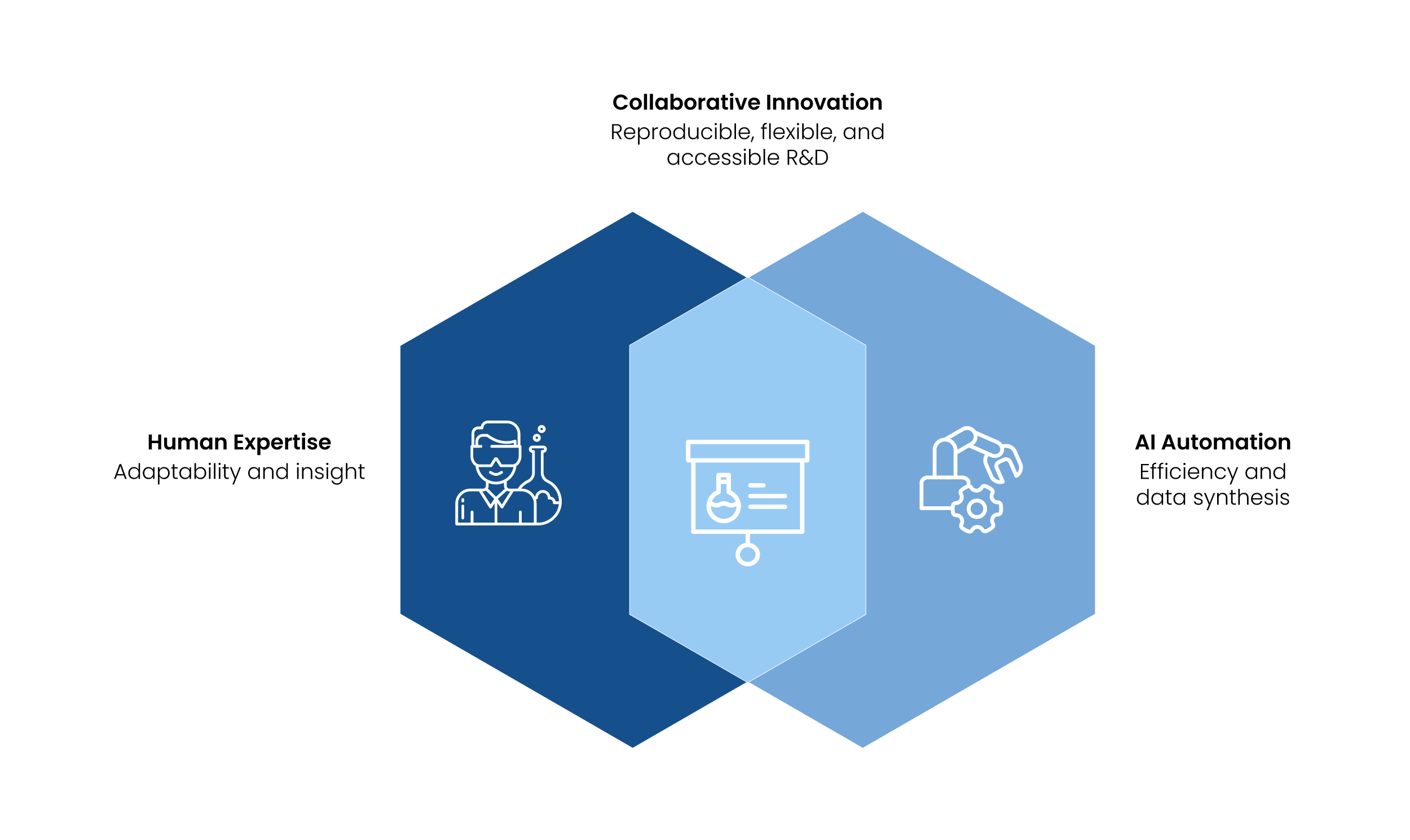
Organized workflows + automated execution + human validation = enhanced reproducibility across locations, runs, and groups. Machines minimize variability. Humans ensure scientific integrity.
2. Rapid Progress from Data to Decisions
AI systems can integrate:
- Assay results
- Variant data
- Historical datasets
- Instrument information
This minimizes human data manipulation. Scientists concentrate on analysis, hypothesis development, and strategic decision-making. Autonomy speeds up processing. Humans speed up understanding.
3. Enhanced Flexibility Compared to Fully Automated Systems
- New targets appearing
- Assay modifications
- Instrument parameter changes
- Unexpected findings
A closed-loop system without human supervision may become rigid. A human-in-the-loop system remains resilient.
4. Democratization of Advanced R&D
Autonomy no longer demands billion-dollar facilities. Mid-sized biotech firms and CROs can adopt:
- Semi-automated processes
- Ai-driven elns
- Organized templates
- Electronic quality controls
Human-assisted autonomy democratizes advanced R&D – it does not monopolize.
Conclusion: The Autonomous Lab—Humans at the Center
Autonomous laboratories have moved from concept to reality, but the future of R&D was never about replacing scientists — it’s about placing them exactly where they’ve always belonged: at the heart of discovery. The most transformative research environments will be those that seamlessly blend human knowledge and intuition with precise machine performance, artificial intelligence, well-structured data, and automated workflows enabled through effective Scientific Data Management.
Enhancing Human Potential Through Autonomy
Autonomous labs aren’t designed to sideline researchers — they’re built to amplify what scientists can achieve. When expert insight is paired with intelligent, self-operating systems, laboratories unlock possibilities that neither humans nor machines could reach alone. The result isn’t a smaller role for scientists; it’s a more powerful one supported by integrated Scientific Applications.
Human-in-the-Loop: The Engine of Faster Innovation
Labs that embrace human-in-the-loop strategies gain the best of both worlds — the consistency and speed of automation alongside the nuance and judgment that only human expertise can provide. By offloading repetitive tasks and streamlining complex workflows, this collaborative model frees researchers to focus on what truly drives progress: asking better questions, challenging assumptions, and interpreting what machines cannot through advanced Bioinformatics Solutions.
AI-Driven Discovery: Getting Breakthroughs to Patients Faster
In pharmaceutical research, the stakes couldn’t be higher. When scientific expertise is embedded within AI-powered, autonomous platforms, drug discovery accelerates — and the path from laboratory insight to patient impact shortens dramatically. The fusion of human intelligence and advanced automation isn’t just reshaping how research is done; it’s redefining how quickly life-changing therapies reach the people who need them most through modern Precision Medicine solutions.