

Contributors: Shawani Shome, Karthik Namburu, Rosario Muthu Rajan Vincent Xavier
Introduction:
In the fast-paced world of scientific research, the transformation of raw data from instruments into actionable insights is a crucial process. This journey involves several critical stages:
- Enabling the Lab Scientist
- Structured Data Capture
- Data Foundation
- Scientific Insights
Each stage plays a vital role in managing diverse types of data across both large and small molecule research, as well as handling complex modalities within preclinical studies. Understanding and optimizing these stages is essential as the demand for quickly and efficiently generating insights from experimental data continues to rise.
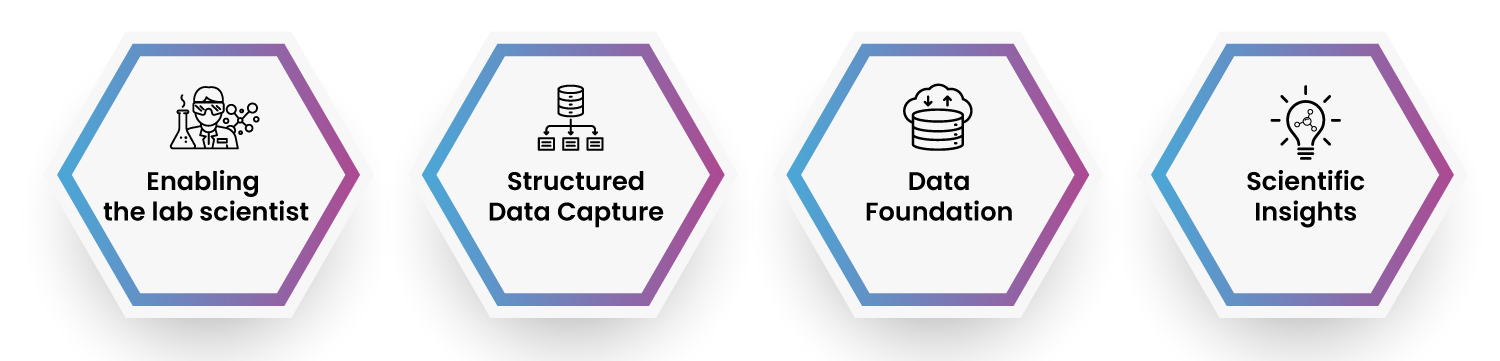
Excelra instrument to insights: lab enablement
In today’s research environment, lab scientists deal with various types of data from different experiments, using a range of instruments. Whether it’s observations or sample and equipment information, tracking and managing this data is essential.
Lab enablement is the first step in this journey, involving the assembly and optimization of laboratory instruments. Ensuring that labs are equipped with the latest tools and technologies, from advanced chromatography systems to next-generation sequencing platforms, sets a strong foundation for subsequent stages of data processing within scientific informatics environments.

Data capture and automation
Once data is generated on a large scale, it’s crucial to capture, store, and manage it efficiently. This is where data capture and automation come into play. Tools and technologies involved at this stage ensure that data is collected accurately and effectively.
The quality of lab instruments directly influences the accuracy of data capture. Moreover, the automated transfer of this data from instruments to databases minimizes errors and enhances efficiency.
Electronic Lab Notebooks (ELNs) and Laboratory Information Management Systems (LIMS) have emerged as key enablers of lab digitalization. These systems help document and manage experimental data, significantly reducing human error and data loss while supporting ELN and LIMS integration.
By automating routine documentation tasks, these tools free up valuable time for scientists, allowing them to focus on research rather than manual data transcription.
Data foundation
Once scientific data is registered, it’s essential to integrate and structure it to create a robust data foundation. A centralized repository, often referred to as a data lake, is used to store vast amounts of raw data.
Platforms such as Snowflake enable scalable data storage and management. After processing, structured data is typically stored in a data warehouse for future retrieval and analysis. Standardizing data is crucial to maintaining consistency and ensuring interoperability across the organization.
This stage is foundational to effective scientific data management and downstream analytics.

Scientific Insights
The final stage is analyzing processed data to derive meaningful scientific insights. Dedicated tools and platforms allow researchers to search, explore, and interpret data from large repositories.
With advancements in technology, a wide range of software applications and dashboards now support data analysis and visualization, making it easier to interpret results. In some cases, coding, scripting, and customization are required to present raw data in a visually understandable format, reducing manual intervention.
Processed data is then delivered to lab scientists, enabling them to strategize studies and design future experiments more effectively. This process is supported by tools such as LIMS, ELNs, data capture solutions, processing software, and data visualization platforms.
A solid infrastructure—combining on-premises systems, cloud-based solutions, high-performance computing, and robust databases—accelerates research significantly. Building and maintaining such systems requires multidisciplinary expertise, including data identification, requirement analysis, and advanced analytics using AI and ML technologies.
Scientific advancements
By transforming instrument-generated data into structured, accessible, and analyzable formats, organizations can drive meaningful scientific advancements. These insights support innovation across chemistry, disease biology, imaging, omics, and assay-based research.

Conclusion
The journey of transforming raw data from laboratory instruments into actionable scientific insights is complex yet highly rewarding. By following the stages outlined above and leveraging the right tools and skill sets, researchers can unlock the full potential of scientific data.
Excelra, with its state-of-the-art expertise and experienced team, supports organizations throughout this journey from instruments to insights. Whether at the beginning of the process or anywhere in between, Excelra provides the knowledge and technical capabilities required to succeed in modern lab informatics and scientific data transformation.
Contact us today to discuss how our ELN & LIMS Managed Services can empower your lab to reach its full potential.